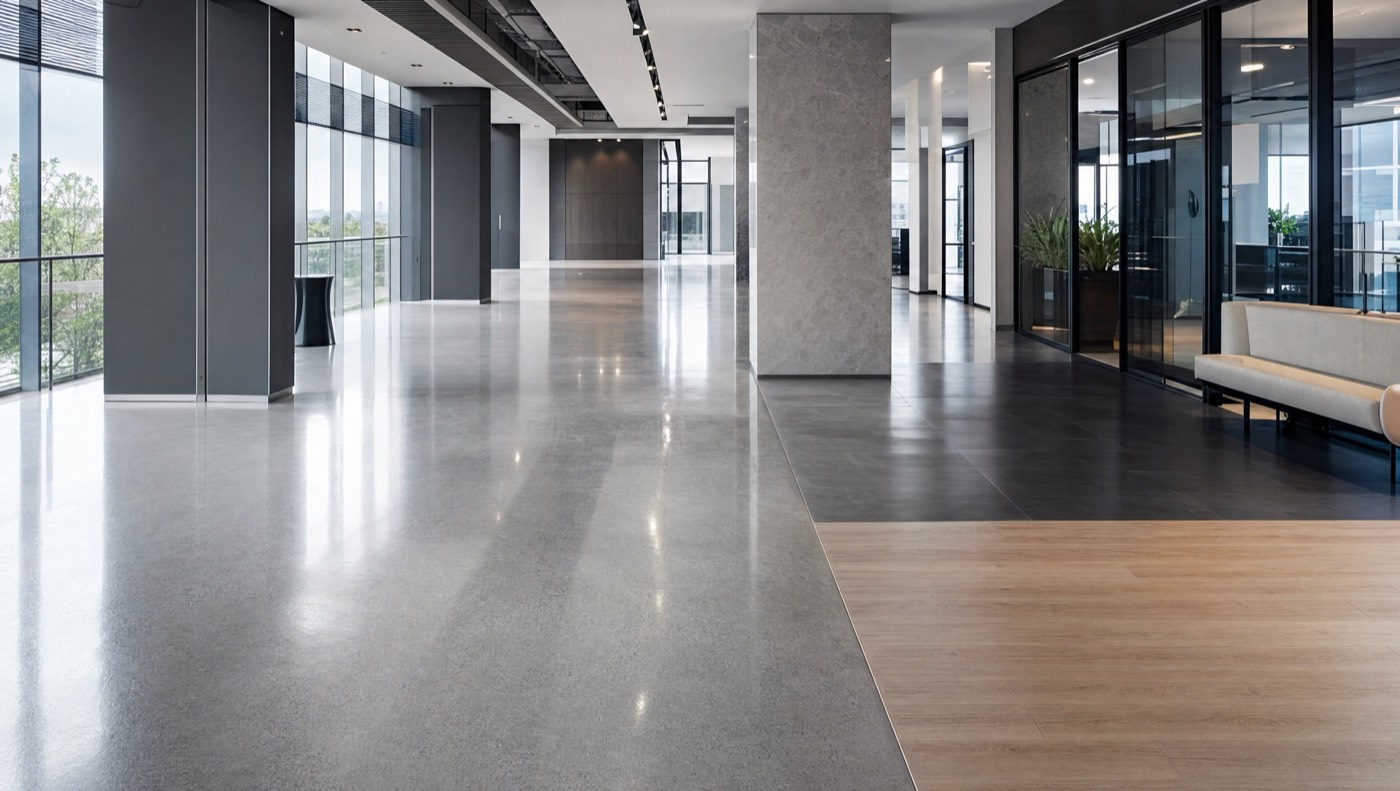
Floor care has its own vocabulary, and a lot of it gets used loosely. This is a plain-English glossary of the terms that come up across stripping, waxing, burnishing, sealing, polishing, and maintenance, with links to deeper explanations where they exist.
| Term | What it means |
|---|---|
| Acrylic finish | The polymer base of most modern floor finish (what people call wax). Builds in coats to a hard, clear, glossy film. See floor finish types. |
| Aggregate | The stone or glass pieces within concrete or terrazzo; grinding exposes it for a polished, speckled look. |
| Auto-scrubber | A walk-behind or ride-on machine that scrubs and vacuums up dirty water in one pass, instead of pushing it around like a mop. |
| Buffing | Low-speed (about 175 to 350 rpm) machine work that cleans and brings up a light shine. See buffing and burnishing. |
| Burnishing | High-speed (about 1500 to 2500+ rpm) machine work that polishes floor finish to a hard, wet-look gloss. See buffing and burnishing. |
| COF / DCOF | Coefficient of friction, the measure of slip resistance. DCOF is the dynamic (moving) value used for hard floors. See slip resistance. |
| Color-seal | A colored grout sealer that coats grout in a uniform color, ideal when grout is stained. See tile and grout cleaning. |
| Cure | The time after a coat dries during which finish reaches full hardness. Burnishing before cure causes powdering. |
| Densifier | A chemical that hardens a concrete surface during polishing, helping it shine and resist wear. |
| Diamond polishing | Grinding a hard surface with progressively finer diamond abrasives to a smooth, reflective finish, used on concrete, terrazzo, and stone. |
| Dust mopping | Dry mopping to remove grit before damp mopping. Grit is the main cause of floor and finish wear. |
| Dwell time | How long a chemical (like stripper) sits to work before it is removed. See stripper types. |
| Efflorescence | A white mineral haze left when moisture moves through concrete, grout, or stone and evaporates. |
| Finish (floor finish) | The protective, glossy, wearable top coating built up over porous tile. Commonly called wax. See finish types. |
| Grit | Two meanings: tracked-in sand and dirt that scratch floors, and the abrasiveness rating of diamond or sanding tools. |
| Hazing | A cloudy look in floor finish, usually from coating a dirty or un-neutralized floor or piling on coats too fast. See finish problems. |
| HEPA | A high-efficiency filter that captures very fine dust, including silica, during grinding. See dust control. |
| Honed | A smooth, low-sheen matte finish on stone or terrazzo, less reflective than a polish. |
| LVT / LVP | Luxury Vinyl Tile and Plank: no-wax flooring with a factory wear layer. See LVT vs. LVP. |
| Maintenance program | A schedule combining cleaning, burnishing, recoats, and strips so floors stay bright. See maintenance programs. |
| Matting (walk-off) | Entry mats that trap grit and moisture before they reach the floor, a top way to protect finish and reduce slips. |
| Neutralize | Returning a stripped floor to neutral pH (and rinsing) so new finish bonds. Skipping it causes yellowing and peeling. |
| No-rinse stripper | A stripper formulated to skip a separate neutralize-and-rinse on lighter builds. See stripper types. |
| Percent solids | The share of a finish that stays on the floor as dry film. Higher means more build per coat. See percent solids. |
| pH-neutral cleaner | A cleaner that is neither acidic nor alkaline, safe for finished floors, stone, and luxury vinyl. |
| Polished concrete | Concrete ground and densified, then diamond-polished to shine, no coating. See what is polished concrete. |
| Powdering | A chalky dust on finished floors, usually from burnishing finish that had not cured. See finish problems. |
| Recoat | Adding one to two fresh coats of finish after scrubbing off the worn top layer. See scrub and recoat. |
| Sealer | The base coat that seals porous tile and bonds the finish, or a penetrating product on stone and concrete. See sealing vs. waxing. |
| Silica (RCS) | Respirable crystalline silica, hazardous dust released when grinding concrete, terrazzo, or stone. See dust control. |
| Spray buff | Buffing with a light maintenance solution to lift scuffs and refresh gloss in one pass. |
| Strike-through | A blotchy look when bare, porous tile absorbs finish unevenly; a sealer base prevents it. |
| Strip and wax | Removing all old finish to the tile and rebuilding with sealer plus several coats. See strip and wax. |
| Stripper | A high-pH alkaline solution that breaks the bond of old finish so it can be removed. See stripper types. |
| Terrazzo | A composite of stone or glass chips in a cement or epoxy matrix, ground and polished. See terrazzo. |
| UHS finish | An ultra-high-speed, burnishable floor finish formulated for high-speed machines and deep gloss. |
| VCT | Vinyl Composition Tile: porous tile that needs floor finish to protect and shine it. See what is VCT. |
| VOC | Volatile organic compounds, solvents that off-gas from some products and cause odor. See low-VOC floor care. |
| Wax | The everyday word for modern floor finish. True paste wax is largely gone from commercial floors. |
| Wear layer | The clear protective top layer of LVT, LVP, and sheet vinyl; what makes them no-wax. |
Start with sealing vs. waxing, finish types, how many coats, or browse all floor care guides.
Need the work done? See strip and wax or build a maintenance program.
In commercial floor care, yes, in practice. Modern floor finish is an acrylic or urethane coating; true paste wax is largely gone. The word wax just stuck.
A sealer is the base coat that seals porous tile and bonds the finish; the finish is the glossy, wearable top layer. See sealing vs. waxing.
Dynamic coefficient of friction, the measure of how slip-resistant a floor is while someone is mid-stride. See slip resistance.
VCT is porous and needs wax; LVT and LVP have a no-wax factory wear layer and are cleaned and protected.
This guide should support both education and conversion: define the issue clearly, explain when the topic affects strip-and-wax, scrub-and-recoat, VCT care, burnishing, polishing, sealing, or maintenance programs, and point the reader to quote, cost, facility, and provider pages where the next step belongs.
Facility type, floor material, square footage, current condition, service needed, timing, access window, photos, traffic areas, safety concerns, and decision-maker contact details.
Photos are optional but helpful. A remote video walkthrough is a convenience option when condition or access is hard to explain. Larger schools, hospitals, universities, municipalities, portfolios, and complex projects may still need an in-person walkthrough.
Strip&Wax.com builds coverage carefully by collecting real facility requirements, provider service areas, capability details, and quote outcomes. The site focuses on accurate scope, clear expectations, and useful commercial floor-care guidance before an opportunity is routed.
Use these related pages to compare services, understand cost, plan facility-specific work, and route the right commercial floor-care opportunity.
Use this page to move from a general floor-care question into the right quote path. Commercial floor work gets easier to price when the buyer identifies the facility type, floor material, condition, timing, and project goal.
Commercial Floor Care Glossary supports the buyer before they request pricing. A useful floor-care guide should help a facility manager understand what to look for, what to photograph, what questions to ask, and which service page to use next. It should also connect the reader to quote-ready pages instead of leaving them at a dead end after reading the article.
The commercial value is in converting research intent into a quote request. When the reader knows whether they need stripping and waxing, scrub-and-recoat, burnishing, floor maintenance, VCT care, tile-and-grout work, or another service, the next click should be obvious and close by.
Do not wait until every detail is perfect. Start the quote request with the basics, then add photos, measurements, floor type, or walkthrough notes when available. Larger schools, hospitals, municipal buildings, retail stores, warehouses, and multi-location properties can add scope details during follow-up.
Request a floor-care quoteTell us your facility, floor types, and square footage. We'll scope the work and send a written quote. Not sure what you have? Send a photo and we'll tell you.