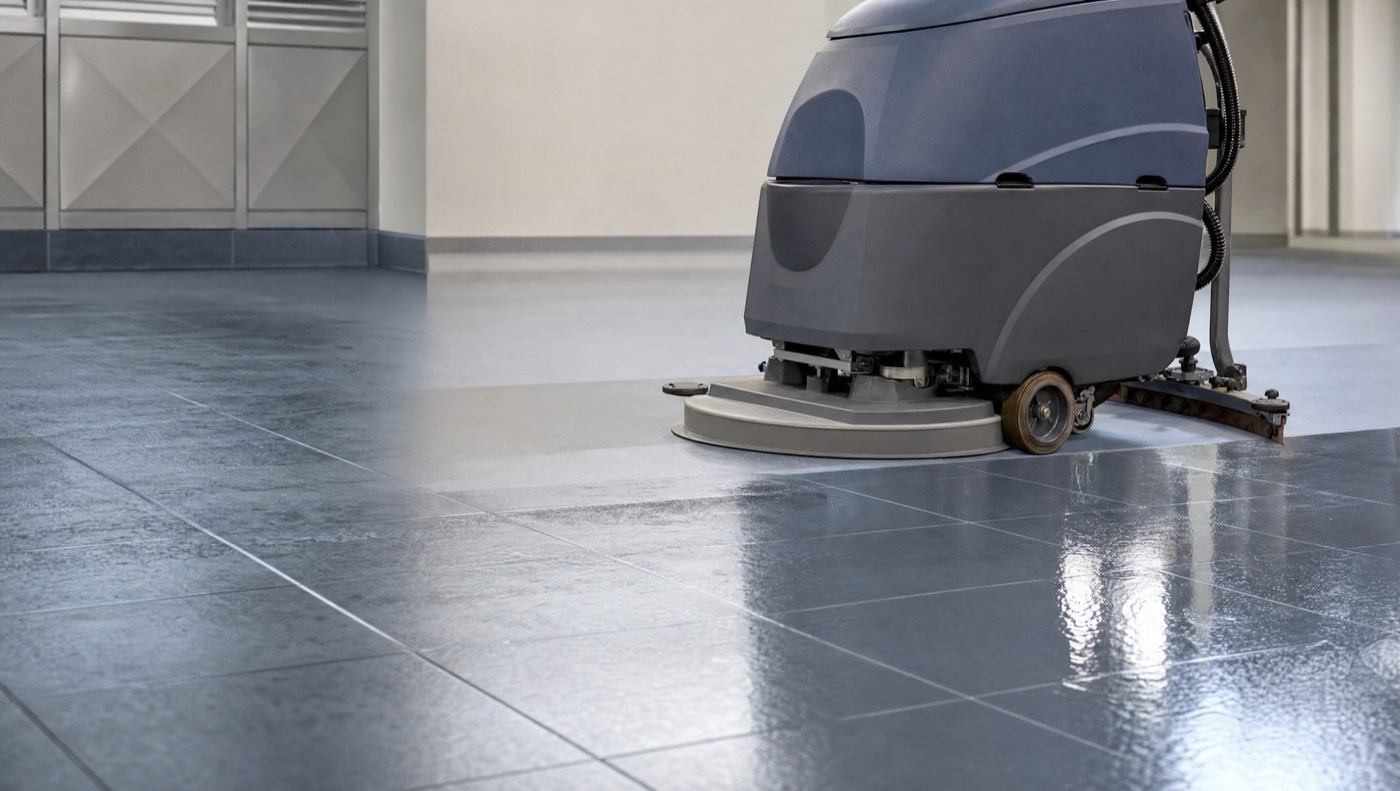
A scrub and recoat is how a smart facility keeps its floors bright without paying for a full strip every time. It pulls off the dirty top layer of finish and lays down fresh coats, so the floor looks renewed at a fraction of the cost and downtime.
Floor finish wears and soils from the top down. A scrub-and-recoat machine-scrubs off that worn, dirty top layer, the floor is rinsed and dried, and one to two coats of fresh finish go back on. The lower, still-good layers stay, so you get a renewed surface without the time, cost, and disruption of stripping down to bare tile.
| Scrub & recoat | Strip & wax | |
|---|---|---|
| Removes | Soiled top layer only | All finish, to the tile |
| Adds | 1 to 2 coats | Sealer plus 4 to 5 coats |
| Cost | Much lower | Highest |
| Downtime | Less | Most |
| Fixes yellowing? | No | Yes |
| Best when | Finish is dull but sound | Finish is yellowed, worn, or built up |
See the full strip and wax service for the deeper reset.
Recoat while the finish is still working, strip once it has failed. Signs it is recoat time, not strip time:
Most standard commercial floors benefit from a scrub-and-recoat on a quarterly rhythm, more often in entries and high-traffic corridors. The point is to recoat before the finish wears down to the tile.
Recoating on a set cadence, with burnishing in between, is exactly what keeps a floor bright and a full strip years apart. A maintenance program schedules it so it never slips.
Related: strip and wax, buffing and burnishing, how many coats of wax, and VCT floor care.
It is a maintenance service that removes the soiled top layer of floor finish with a scrub, then applies one or two fresh coats. It refreshes the shine and protection without a full strip down to the tile.
A strip removes all the finish and rebuilds it with a sealer plus several coats; a recoat removes only the dirty top layer and adds one or two coats. Recoat costs and disrupts far less.
Often quarterly in standard commercial space, more in high-traffic areas. The goal is to recoat before the finish wears down to the tile, which is what keeps a full strip years apart instead of annual.
No. Yellowing lives in the lower layers, so it takes a full strip to remove. Recoating refreshes a finish that is dull or lightly worn but still sound and clear.
It runs well below a full strip and wax, roughly $0.20 to $0.90 per square foot depending on size and condition. Because it extends the life of the finish, it lowers cost over the year.
Less than a full strip, since there is no stripping or neutralizing stage. Most areas are done overnight and ready by opening.
Only floors that carry finish, like VCT. It is not used on no-wax luxury vinyl, stone, or hardwood, which are maintained differently.
Not if it is done correctly. The scrub removes the worn top layer before recoating, so the build stays in a healthy range between full strips.
Service pages must explain the buying decision: when a full strip-and-wax is appropriate, when scrub-and-recoat is enough, what changes cost, what preparation helps, what mistakes to avoid, and how ongoing maintenance prevents emergency floor recovery.
Facility type, floor material, square footage, current condition, service needed, timing, access window, photos, traffic areas, safety concerns, and decision-maker contact details.
Photos are optional but helpful. A remote video walkthrough is a convenience option when condition or access is hard to explain. Larger schools, hospitals, universities, municipalities, portfolios, and complex projects may still need an in-person walkthrough.
Strip&Wax.com builds coverage carefully by collecting real facility requirements, provider service areas, capability details, and quote outcomes. The site focuses on accurate scope, clear expectations, and useful commercial floor-care guidance before an opportunity is routed.
Use these related pages to compare services, understand cost, plan facility-specific work, and route the right commercial floor-care opportunity.
Commercial floor-care buyers are usually trying to protect a facility, prepare for traffic, improve presentation, control safety risk, or restore floors before a deadline. The best quote requests connect the floor problem to the service, floor type, facility type, schedule, and access requirements.
High-value requests often include thousands of square feet, multiple rooms, heavy traffic lanes, old finish buildup, school or healthcare scheduling windows, retail entrances, warehouse walkways, municipal procurement steps, or a multi-location maintenance need. The buyer should understand that price changes with condition and access, not just square footage.
Useful quote notes include the facility type, floor material, current condition, deadline, preferred service window, whether furniture or shelving must move, whether the building needs low-odor products, and whether photos or a remote walkthrough can show the problem better than a written description.
Use the links below to compare scrub vs strip, review VCT floor care, check industry examples, estimate pricing with the cost calculator, or request a quote.
Use these resources to narrow the request into the right service, surface, and facility type: commercial floor waxing, floor stripping and waxing, VCT maintenance, scrub-and-recoat, burnishing, school floor care, healthcare floor care, retail floor care, and industrial floor maintenance. The buyer does not need every technical term before submitting the request.
Use this page to move from a general floor-care question into the right quote path. Commercial floor work gets easier to price when the buyer identifies the facility type, floor material, condition, timing, and project goal.
This page helps facility buyers turn a floor problem into a quote-ready request. Use the service links, floor-type pages, industry examples, planning guides, and quote form to share enough context without overcomplicating the first step.
Floor-care leads are high-ticket because a single job can involve thousands of square feet, after-hours labor, multiple coats of finish, equipment, chemistry, access coordination, and reopening deadlines. The content should make those buying factors clear while keeping the CTA simple: request a quote, send photos if available, and use a walkthrough when the condition needs more context.
Do not wait until every detail is perfect. Start the quote request with the basics, then add photos, measurements, floor type, or walkthrough notes when available. Larger schools, hospitals, municipal buildings, retail stores, warehouses, and multi-location properties can add scope details during follow-up.
Request a floor-care quoteTell us your facility, floor types, and square footage. We'll scope the work and send a written quote. Not sure what you have? Send a photo and we'll tell you.