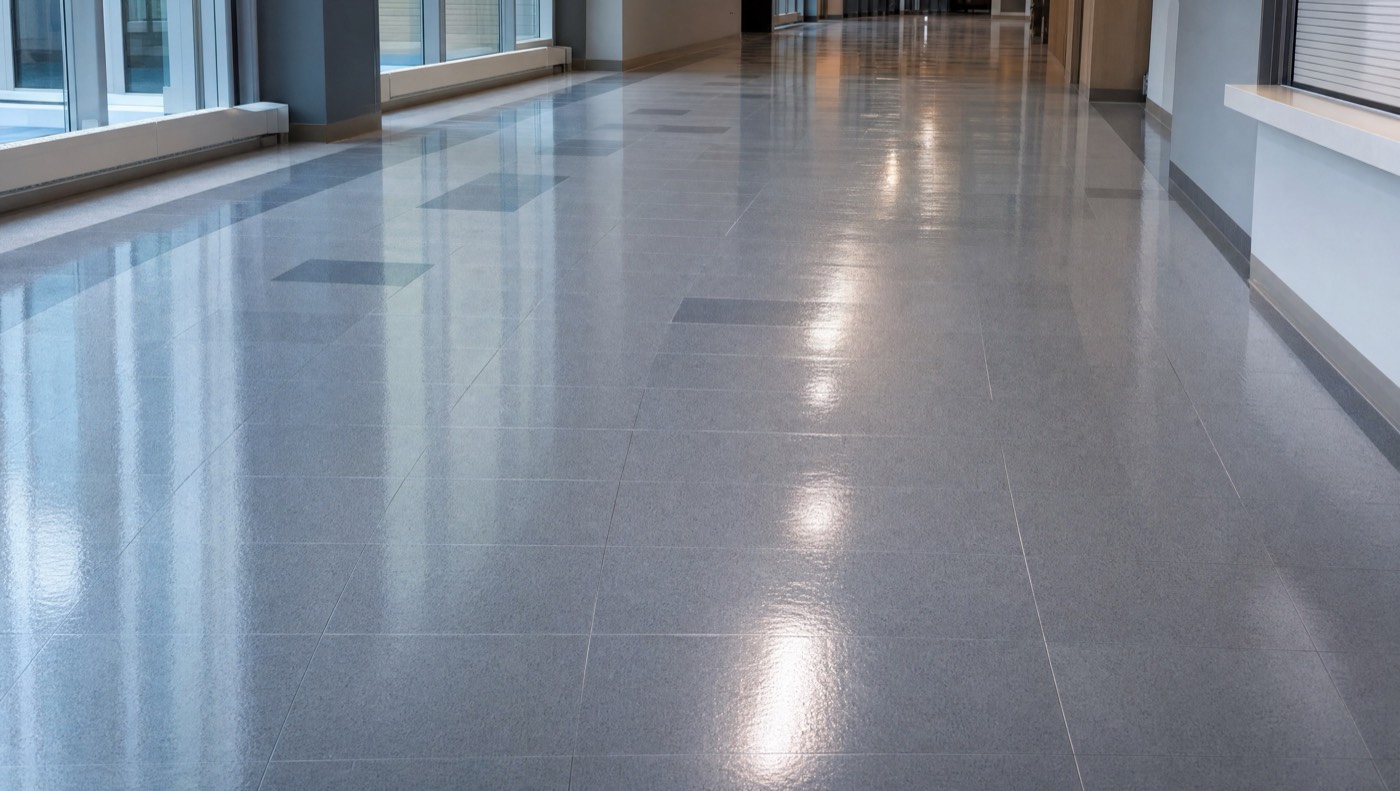
Use this page to scope dull, yellowed, peeling, or heavily built-up floors. A clear request helps define floor type, finish condition, square footage, access windows, number of coats, and whether photos or a walkthrough are needed.
Floor finish (often called wax) is a protective coating built up in thin layers over porous tile like VCT. Over time it yellows, dulls, traps soil, and wears through. Stripping chemically dissolves and removes every layer down to the bare tile; waxing then rebuilds the protection with a sealer base and several coats of fresh finish. It is the deepest, most complete floor service, and the foundation everything else maintains.
Not every dull floor needs a full strip. The cheapest path that still protects the floor is usually the right one.
| Strip & wax | Scrub & recoat | |
|---|---|---|
| Removes | All finish, down to the tile | Only the soiled top layer |
| Adds | Sealer plus 4 to 5 coats | 1 to 2 coats |
| Relative cost | Highest | Much lower |
| Downtime | Most | Less |
| Best when | Finish is yellowed, worn, or built up | Finish is dull but still sound |
More on the lighter option: scrub and recoat.
| Facility or area | Typical full strip and wax |
|---|---|
| Low-traffic offices and private areas | Once a year or less |
| Standard commercial and retail | 1 to 2 times a year |
| Schools (summer and winter breaks) | 1 to 2 times a year |
| High-traffic entries and healthcare corridors | 2+ times a year, with frequent recoats |
Between strips, scrub-and-recoat and burnishing keep the floor bright and stretch the interval, which is exactly what a maintenance program schedules.
Stripping and waxing is for porous tile that depends on finish. Using it on the wrong floor is a costly mistake.
Estimate your job with the cost calculator, or read the full cost guide.
Most floor-finish problems trace back to shortcuts in the strip. Here is what goes wrong, and why it does not happen on a proper job.
VCT is cheapest over its life when it is maintained, not rescued. A maintenance program times the strip, the scrub-and-recoats, and the burnishing so the floor never reaches the yellowed, worn-through stage in the first place.
Related: strip-and-wax cost guide, cost calculator, how many coats of wax, floor stripper types, and VCT floor care.
Commercial strip and wax typically runs $0.50 to $3.00 per square foot, depending on the floor's condition, the size of the job, access, and how many coats it needs. Scrub-and-recoat costs well below that. Use our cost calculator for an estimate.
Most commercial floors get a full strip and wax once or twice a year, with scrub-and-recoats and burnishing in between. High-traffic entries and corridors may need it more often; low-traffic areas less.
Usually a sealer plus four to five coats of finish on stripped VCT, with extra coats in the highest-traffic lanes. More detail is in our guide on how many coats.
A typical zone is done overnight, because each coat of finish has to dry before the next. Large facilities are scheduled in sections so areas reopen as they're finished.
Usually we work after hours or overnight so the area is dry and ready when you open. For occupied spaces we section the work to keep you running.
Almost always old finish that wasn't fully stripped, finish applied over residue, or low-quality product. A proper strip, neutralize, and rinse before refinishing prevents it.
No. VCT and similar porous tile need finish. Luxury vinyl (LVT/LVP), most stone, and hardwood are not waxed; they are cleaned, polished, sealed, or recoated instead.
With burnishing and scrub-and-recoats between strips, a good finish build holds up for months to a year or more before a full strip is needed, depending on traffic.
A properly applied and burnished finish is designed for traction underfoot. Slip risk usually comes from wet floors or improper product, not from a correct finish build.
Stripping removes all the old finish down to the tile and rebuilds it; a scrub-and-recoat removes only the soiled top layer and adds one or two coats. Recoat when the finish is dull but sound, strip when it's yellowed, worn, or built up.
Most VCT (vinyl composition tile) needs a full strip and wax on a 6–12 month cycle, with scrub-and-recoat in between. See our full VCT floor care guide for the schedule and common problems.
Full strip-and-wax is the right call when old finish is failing: yellowed layers, wax buildup, embedded soil, peeling, cloudy finish, dark traffic lanes, or uneven shine. If the finish is still bonded, a scrub-and-recoat may save money and downtime.
Best for VCT and compatible resilient floors with failed, contaminated, heavily built-up, or worn-through finish. The old finish is removed before new sealer/finish coats go down.
Best when the finish is dull or lightly scratched but still bonded. It refreshes the top layers and keeps the floor on schedule between full stripping cycles.
Large schools, hospitals, universities, municipalities, portfolios, or uncertain floor conditions may need a remote or in-person walkthrough before final pricing.
Use the calculator for a planning range, then request a written commercial quote with floor details and timing.
Use the cost calculator · Read the cost guide
Request a strip-and-wax quoteA provider cannot price a commercial strip-and-wax job well from square footage alone. The condition of the old finish, how much buildup is along walls and corners, whether furniture must move, and how quickly the space must reopen all affect labor, chemistry, drying time, and final price.
If the job is urgent or the floor condition is unclear, do not wait to write a perfect scope. Start the request, attach photos if available, and use a phone review, remote walkthrough, or in-person walkthrough only when it helps clarify the project.
Start the quote requestA good floor-care request starts with the building, the floor condition, and the schedule. Tell us what the floor looks like now, where the work needs to happen, and when the space needs to reopen.
Describe dull finish, yellowing, wax buildup, peeling, stains, dark edges, damaged tile, traffic lanes, or areas that still look dirty after routine cleaning.
Share whether the work needs to happen overnight, on a weekend, during a school break, around tenants, before an event, or before a reopening deadline.
Name the surface if you know it: VCT, LVT, tile and grout, concrete, terrazzo, rubber, gym flooring, hardwood, marble, or a mix of surfaces.
Some commercial floors need a full strip-and-wax. Others can be improved with scrub-and-recoat, burnishing, deep cleaning, tile and grout work, concrete scrubbing, or a maintenance program.
The first request does not have to be perfect. Send the facility type, city or ZIP, floor issue, timing, and contact details. If the project is large or hard to explain, photos or a short walkthrough can help clarify the scope after the first contact.
Schools, clinics, offices, retail stores, churches, warehouses, gyms, and managed properties all have different traffic patterns and access limits. The quote request should reflect those operating realities.
Hallways, classrooms, cafeterias, gyms, summer breaks, winter breaks, reopening dates, and student traffic all affect the floor-care plan.
School floor careQuiet work windows, patient or staff traffic, tenant schedules, lobbies, corridors, break rooms, and odor sensitivity can change the best method.
Healthcare floor careEntrances, checkout lanes, aisles, docks, warehouse routes, carts, forklifts, and customer visibility can make timing and durability more important.
Retail floor careTell us your facility, floor types, and square footage. We'll scope the work and send a written quote. Not sure what you have? Send a photo and we'll tell you.