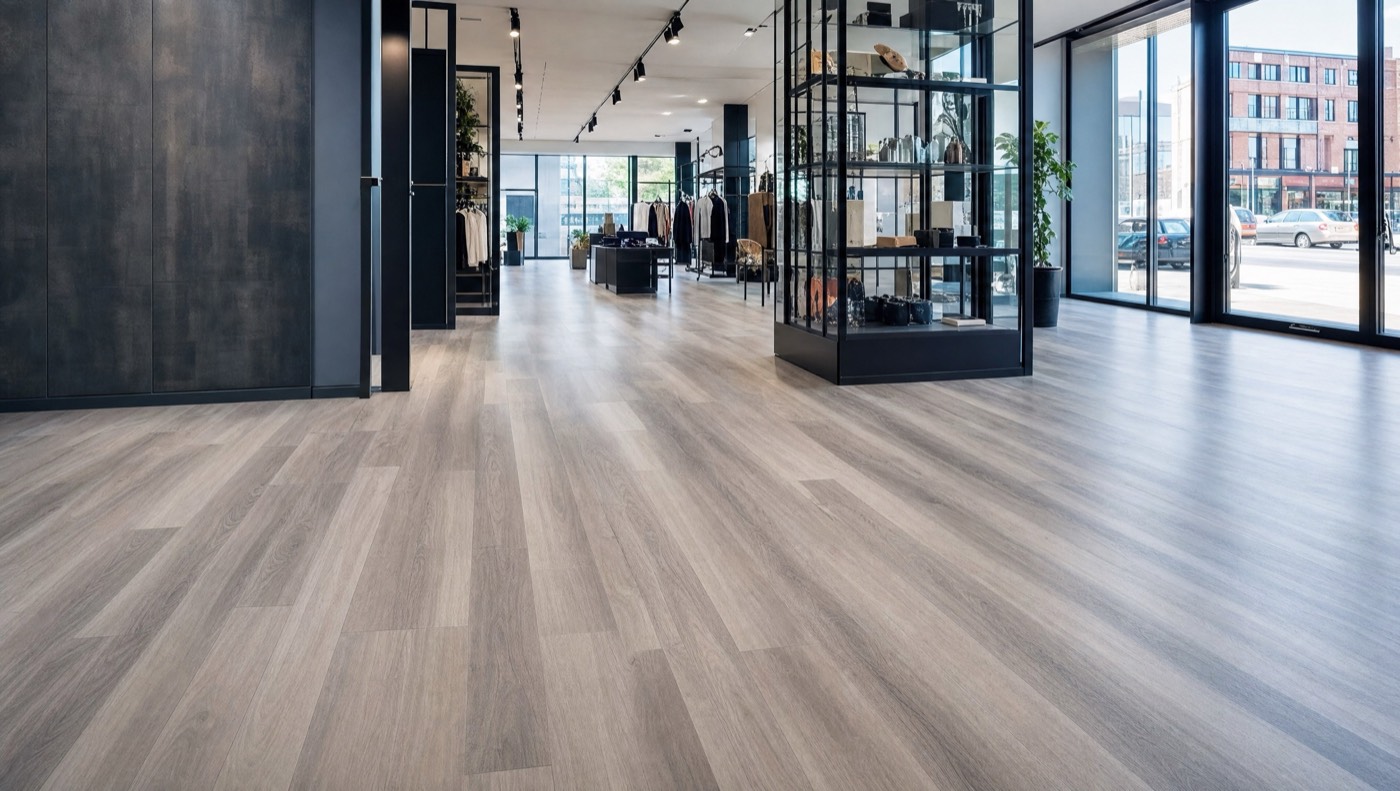
LVT and LVP are the same family of flooring, luxury vinyl. LVT is luxury vinyl tile, LVP is luxury vinyl plank. The only real difference is the shape, and both are built around a printed design layer and a tough, no-wax wear layer. This guide covers the difference, the construction, how to choose, how to maintain it, and the problems to avoid.
Luxury vinyl is a multi-layer floor that prints a high-resolution wood, stone, or tile image onto a vinyl plank or tile and protects it with a clear wear layer. It took over commercial and residential interiors over the last decade because it looks like the real material, handles water and traffic far better than laminate or real wood, and costs less to install and maintain than stone or hardwood. LVT and LVP are the two formats of that same product.
People often say LVT to mean the whole category. When the distinction matters, it's simply tile versus plank, and the look that comes with each.
| LVT (Luxury Vinyl Tile) | LVP (Luxury Vinyl Plank) | |
|---|---|---|
| Shape | Square or rectangular tiles | Long planks |
| Typical look | Stone, ceramic, concrete, marble | Hardwood |
| Common sizes | 12x12, 12x24, 18x18 in | 6x48, 7x48, 9x60 in |
| Where it fits | Lobbies, restrooms, retail, stone accents | Offices, corridors, retail, wood looks |
| Construction | Identical luxury vinyl build: backing, core, printed film, wear layer | |
From the bottom up, every luxury vinyl plank or tile is built from the same layers. The two that drive performance are the wear layer (durability) and the core (stability and feel).
| Wear layer | Best suited for |
|---|---|
| 6–12 mil | Residential and very light traffic |
| 12–20 mil | Light commercial |
| 20–28 mil | General commercial |
| 28–40 mil and up | Heavy commercial and high traffic |
A mil is one thousandth of an inch. For commercial buildings, the wear layer matters far more than the total plank thickness, it's what stands between traffic and the printed image.
| Core | What it is | Strengths and feel |
|---|---|---|
| SPC (stone-plastic) | Limestone powder plus PVC, rigid | Hardest and most dimensionally stable; resists dents and handles temperature swings; firmer underfoot |
| WPC (wood-plastic) | Wood flour plus PVC, rigid | Softer, warmer, and quieter; more comfortable to stand on, slightly less dent-resistant |
| Flexible / dryback | Thin flexible vinyl, glued down | Conforms to the subfloor and handles heavy rolling loads when fully bonded; needs a very flat, sound subfloor |
For heavy commercial traffic and rolling loads, a glued-down floor (rigid or flexible) usually outperforms a floating one. The right core depends on the subfloor, the traffic, and the comfort you want.
Installation method affects how the floor handles heat, rolling loads, and repairs, which in turn affects maintenance. We work with what's installed.
The factory wear layer is engineered to be the finished surface. That's the whole point of luxury vinyl: the protection is built in. Stripping and waxing it adds a layer it was never meant to carry, and high-speed burnishing generates heat the wear layer can't take. Both can haze or cloud the surface, cause adhesion problems, and void the manufacturer's warranty. Luxury vinyl is cleaned and protected, not stripped and refinished. See LVT and luxury vinyl floor care for the service side.
Because luxury vinyl is no-wax, maintenance is about protecting the factory wear layer, not stripping and refinishing. A light-touch maintenance program keeps it looking new with the right chemistry and the right equipment, which is most of the battle.
| Do | Don't |
|---|---|
| Dust mop or sweep daily to remove grit | Wax or strip-and-wax it |
| Damp mop with a pH-neutral, approved cleaner | Use harsh solvents, abrasives, or stripper |
| Use felt pads under furniture and walk-off mats at entries | High-speed burnish (heat damages the wear layer) |
| Address spills promptly | Flood the floor or let water sit at seams |
| Apply a manufacturer-approved finish only where allowed | Use rubber-backed mats that can stain vinyl |
| Floor | What it is | How it's maintained |
|---|---|---|
| Luxury vinyl (LVT/LVP) | PVC plank or tile with a printed film and a wear layer | Clean and protect, no-wax |
| VCT | Vinyl plus mineral filler, porous tile | Strip and wax on a cycle |
| Laminate | Wood-fiber (HDF) core with a printed image | Dry or barely-damp clean; not waxed; less water-resistant |
| Sheet vinyl | Vinyl in large rolls instead of tiles or planks | Clean; some commercial sheet takes a finish |
Next: LVT and luxury vinyl care (the service), what is VCT, sealing vs. waxing, and maintenance programs.
Format. LVT is luxury vinyl tile, usually square or rectangular and printed to look like stone or ceramic. LVP is luxury vinyl plank, long boards printed to look like hardwood. The construction is the same luxury vinyl build; only the shape and the look differ.
Neither is better as a material, they're the same family. Choose by look (stone and tile go to LVT, wood goes to LVP) and pick the wear-layer thickness and core for the space and traffic.
No. Both have a factory no-wax wear layer. Waxing isn't needed, can haze the surface, and can void the warranty. Clean and protect with manufacturer-safe methods instead.
Sweep or dust mop daily to remove grit, then damp mop with a pH-neutral, manufacturer-approved cleaner. Avoid harsh strippers and solvents, abrasive pads, and high-speed burnishing.
As a rule of thumb, 20 mil and up for general commercial traffic and 28 to 40 mil for heavy commercial. Lighter 12 to 20 mil suits light commercial; 6 to 12 mil is residential.
Both are rigid cores. SPC (stone-plastic composite) is denser, harder, more dimensionally stable, and more dent-resistant. WPC (wood-plastic composite) is softer, warmer, and quieter underfoot.
No. VCT is porous and must be sealed and waxed. Luxury vinyl has a built-in wear layer and is no-wax, cleaned and protected rather than stripped and waxed.
Most rigid-core luxury vinyl is highly water-resistant or waterproof at the plank itself. Seams, edges, and the subfloor still matter, so standing water and flooding are not risk-free.
Often. Haze from waxing or the wrong cleaner can usually be corrected with manufacturer-safe methods. Deep scratches that reach the printed design layer can't be polished out; that plank is replaced.
Usually thermal expansion in a floating floor: missing expansion gaps, no acclimation before install, or direct heat and sun. Glue-down installs and proper expansion gaps prevent it.
Only a manufacturer-approved finish, and only where the warranty allows it. It's optional, for added gloss or durability, not a maintenance requirement.
No. The factory wear layer is the protective surface, so luxury vinyl is not sealed or waxed the way porous floors are.
Use this page to move from a general floor-care question into the right quote path. Commercial floor work gets easier to price when the buyer identifies the facility type, floor material, condition, timing, and project goal.
LVT vs. LVP: What Is Luxury Vinyl? supports the buyer before they request pricing. A useful floor-care guide should help a facility manager understand what to look for, what to photograph, what questions to ask, and which service page to use next. It should also connect the reader to quote-ready pages instead of leaving them at a dead end after reading the article.
The commercial value is in converting research intent into a quote request. When the reader knows whether they need stripping and waxing, scrub-and-recoat, burnishing, floor maintenance, VCT care, tile-and-grout work, or another service, the next click should be obvious and close by.
Do not wait until every detail is perfect. Start the quote request with the basics, then add photos, measurements, floor type, or walkthrough notes when available. Larger schools, hospitals, municipal buildings, retail stores, warehouses, and multi-location properties can add scope details during follow-up.
Request a floor-care quoteTell us your facility, floor types, and square footage. We'll scope the work and send a written quote. Not sure what you have? Send a photo and we'll tell you.