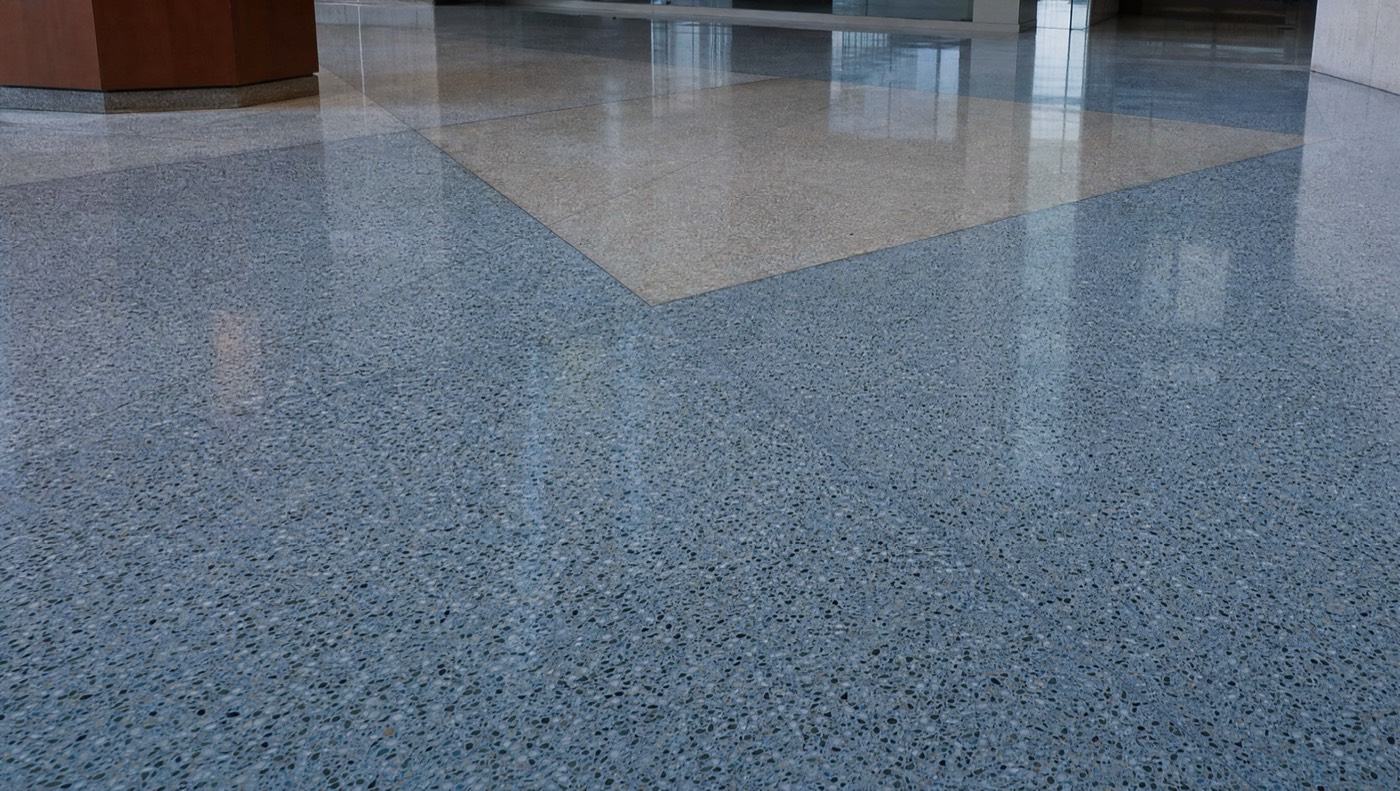
Under a lot of yellowed, waxed, tired-looking floors in schools, courthouses, and old commercial buildings is terrazzo, a surface built to last a century. Restoring it almost always beats replacing it, and the transformation is dramatic. Here is how restoration works and how to think about whether it is worth it.
The result is the stone itself shining, no wax involved. How we deliver it is on the terrazzo service page.
| Restore | Replace | |
|---|---|---|
| Cost | Lower; work the existing slab | Much higher; demo plus new install |
| Downtime | Shorter | Long, disruptive |
| Character | Keeps original, often historic, terrazzo | New look, original lost |
| Lifespan after | Decades more from a proven floor | Decades, but starting over |
Because terrazzo is so durable, the slab is usually still sound under the wax. That is why restoration is the default recommendation and replacement is rare.
Terrazzo can be repaired, not just refinished. Cracks are cleaned and filled, and chips or holes are patched with matching material and blended into the polish, so repairs largely disappear. Uneven tiles or sections (lippage) are ground flat during restoration. Structural cracking, as opposed to cosmetic, should be evaluated by a structural professional before refinishing.
Traditional terrazzo uses a cement matrix; modern terrazzo often uses a thinner epoxy matrix. Both are restored by grinding and polishing, with the method tuned to the matrix and aggregate. Older buildings typically have cement terrazzo, exactly the kind that has been buried under wax for decades and responds dramatically to restoration.
Terrazzo restoration is priced per project, by the floor's condition, size, and how much grinding and repair it needs, so it is scoped on assessment rather than a blanket rate. The key economic point stands regardless: restoring a sound, century-capable floor almost always costs far less than replacing it. Afterward, maintenance is simple and wax-free, neutral-cleaner mopping or auto-scrubbing and periodic re-polishing, ideally on a maintenance program so it never slides back under buildup.
Related: terrazzo floor care, marble and stone polishing, dust control, and maintenance programs.
Have terrazzo hiding under old wax? Get a terrazzo assessment and see what is under there.
Almost always. Grinding, honing, and polishing remove decades of wax, stains, scratches, and etching and bring the original terrazzo back.
Old wax and coatings are stripped, then the surface is diamond-ground, honed, and polished, densified, and sealed, so the stone itself shines without wax.
Restoring is almost always far cheaper, because the durable slab is usually still sound under the wax and tearing it out for a new install is expensive and disruptive.
No. Modern terrazzo care is polishing and sealing, not waxing. Wax yellows and dulls it; if your terrazzo is waxed, it can be removed and the natural finish restored.
It depends on size and condition, since grinding and multiple polishing passes take time, but it is typically scheduled in sections to limit disruption.
Yes. Cracks are filled and chips patched with matching material and blended into the polish. Structural cracking should be assessed by a structural professional first.
Properly maintained, terrazzo can last the life of the building, which is why restoring it is usually a better investment than replacing it.
It is priced per project by condition, size, and the grinding and repair needed, so it is scoped on assessment. The constant is that it almost always beats replacement on cost.
This guide should support both education and conversion: define the issue clearly, explain when the topic affects strip-and-wax, scrub-and-recoat, VCT care, burnishing, polishing, sealing, or maintenance programs, and point the reader to quote, cost, facility, and provider pages where the next step belongs.
Facility type, floor material, square footage, current condition, service needed, timing, access window, photos, traffic areas, safety concerns, and decision-maker contact details.
Photos are optional but helpful. A remote video walkthrough is a convenience option when condition or access is hard to explain. Larger schools, hospitals, universities, municipalities, portfolios, and complex projects may still need an in-person walkthrough.
Strip&Wax.com builds coverage carefully by collecting real facility requirements, provider service areas, capability details, and quote outcomes. The site focuses on accurate scope, clear expectations, and useful commercial floor-care guidance before an opportunity is routed.
Use these related pages to compare services, understand cost, plan facility-specific work, and route the right commercial floor-care opportunity.
Commercial floor-care buyers are usually trying to protect a facility, prepare for traffic, improve presentation, control safety risk, or restore floors before a deadline. The best quote requests connect the floor problem to the service, floor type, facility type, schedule, and access requirements.
High-value requests often include thousands of square feet, multiple rooms, heavy traffic lanes, old finish buildup, school or healthcare scheduling windows, retail entrances, warehouse walkways, municipal procurement steps, or a multi-location maintenance need. The buyer should understand that price changes with condition and access, not just square footage.
Useful quote notes include the facility type, floor material, current condition, deadline, preferred service window, whether furniture or shelving must move, whether the building needs low-odor products, and whether photos or a remote walkthrough can show the problem better than a written description.
Use the links below to compare scrub vs strip, review VCT floor care, check industry examples, estimate pricing with the cost calculator, or request a quote.
Use these resources to narrow the request into the right service, surface, and facility type: commercial floor waxing, floor stripping and waxing, VCT maintenance, scrub-and-recoat, burnishing, school floor care, healthcare floor care, retail floor care, and industrial floor maintenance. The buyer does not need every technical term before submitting the request.
Use this page to move from a general floor-care question into the right quote path. Commercial floor work gets easier to price when the buyer identifies the facility type, floor material, condition, timing, and project goal.
Terrazzo Restoration: How It Works, What It Costs, and When It Is Worth It supports the buyer before they request pricing. A useful floor-care guide should help a facility manager understand what to look for, what to photograph, what questions to ask, and which service page to use next. It should also connect the reader to quote-ready pages instead of leaving them at a dead end after reading the article.
The commercial value is in converting research intent into a quote request. When the reader knows whether they need stripping and waxing, scrub-and-recoat, burnishing, floor maintenance, VCT care, tile-and-grout work, or another service, the next click should be obvious and close by.
Do not wait until every detail is perfect. Start the quote request with the basics, then add photos, measurements, floor type, or walkthrough notes when available. Larger schools, hospitals, municipal buildings, retail stores, warehouses, and multi-location properties can add scope details during follow-up.
Request a floor-care quoteTell us your facility, floor types, and square footage. We'll scope the work and send a written quote. Not sure what you have? Send a photo and we'll tell you.